
Warrior Pose, Warrior Heart
This week's question comes from a yoga student about their hips:
Dear YT,
My hips are always in pain. I've tried stretches like pigeon pose in different ways. I can feel the stretch, but they continue to hurt. I also currently am having sciatic nerve pain down my leg and though the hip pain seems chronic, the sciatica is sporadic.
Also, do you know anything about Lymphedema or lymphatic drainage exercises? I am recovering from recent breast cancer treatment (surgery, chemo, radiation and immunotherapy) and was wondering if there is anything you know that might assist me and that I might implement in my practice?
Thank you, Ronny!
You are a source of inspiration.
Warrior pose, Warrior heart
Dear Warrior Pose, Warrior Heart,
Can I just take a moment to honor you? Chemotherapy, radiation, surgery, immunotherapy — and somewhere in the middle of all of that, you kept coming back to your mat. You kept asking questions. You kept showing up for yourself. That kind of devotion to your own healing is quite remarkable, and I don’t want to just scroll past it.
Now. Let’s talk about those hips.
Hip pain and sciatic nerve pain can be related, but they don’t have to be. The sciatic nerve begins in the lower back, travels through the pelvis, and makes its way down the back of the leg. When it gets irritated or compressed anywhere along that path, it can produce pain that shows up in the hip area — but your hip pain may also be its own separate thing entirely, living next door to the sciatica without much connection at all. Two conditions, one body, a lot of noise. This is exactly why seeing a doctor about your hip — not just your cancer treatment — matters so much. But more on that in a moment.
I want to be careful here because pigeon is not a bad pose. It’s actually a reasonable thing to reach for when the sciatic nerve is grumpy. The pose works on the piriformis muscle, a deep hip rotator that can sometimes press on the sciatic nerve when it’s tight, and stretching it makes a certain kind of sense. So your instinct wasn’t wrong. However, feeling stretched and solving a problem are not always the same thing. Pigeon pose, particularly the full floor version, puts a bit of demand on the hip joint itself — and if the hip is already unhappy for its own reasons, all that sensation you’re feeling may not be the productive kind. What helps one thing can quietly be hurting another. You can be doing something genuinely useful for your sciatic nerve while simultaneously asking too much of your hip joint. That is not a failure on your part. That is just a body being complicated.
So what might serve you better?
Supine figure-four is essentially pigeon’s kinder, gentler cousin. You lie on your back, cross one ankle over the opposite thigh, and let gravity do the work without loading the hip joint. You get a similar conversation with the piriformis and the deep hip rotators, but from a position that gives your hip a lot more support and a lot more say in how far things go. Supported bridge pose is worth exploring too — not as a deep stretch, but as a gentle strengthening posture. Slipping a block under your sacrum and simply resting there allows the hip flexors to release while the posterior body gets a little passive support. Over time, working into a more active bridge helps build the kind of quiet strength around the hips and pelvis that makes everything feel more stable and less reactive.
Now, to your question about lymphedema.
This is an area where yoga has something genuinely useful to offer, and also an area where I want to be honest about the edges of my lane. I am a yoga therapist, not an oncologist or a lymphedema specialist, so what I can offer you here is general guidance, and a strong encouragement to loop in your medical team before adding anything new to your practice.
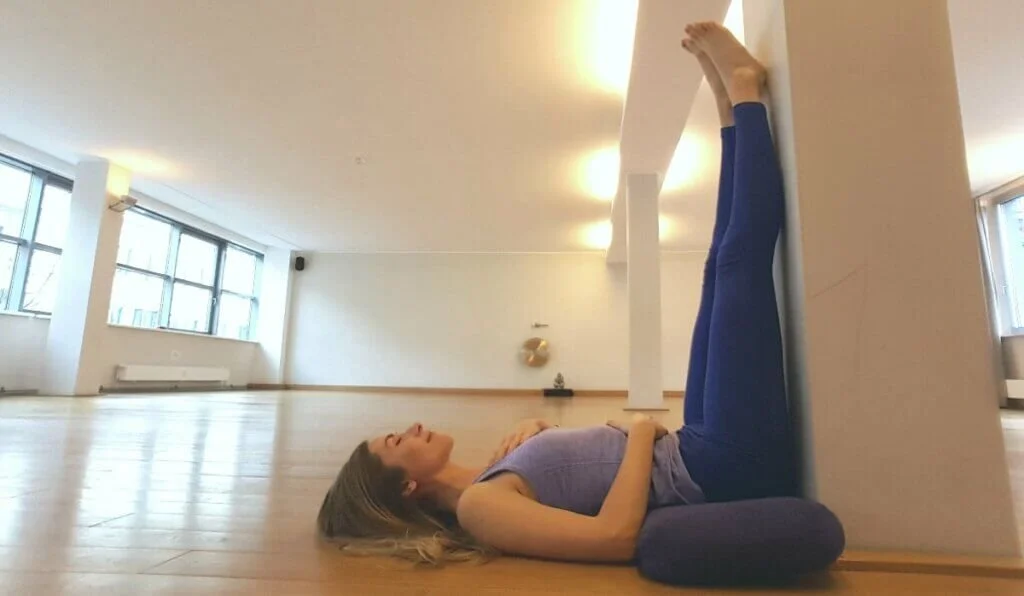
That said, here is what I know. The lymphatic system doesn’t have a pump the way the cardiovascular system has the heart. It relies on movement, breath, and gravity to keep things flowing. Yoga, practiced gently and thoughtfully, can be a genuinely supportive tool. Gentle inversions like legs up the wall (viparita karani) and bridge pose with your feet against the wall encourage lymphatic and venous return by using gravity to assist fluid back toward the torso. They are restful, they are accessible, and they ask very little of a body that has already given so much. Please check with your doctor before introducing these, as every post-treatment body has its own particular needs and contraindications.
Your ankles and calves are also asking for attention.
Simple ankle circles, gentle flexion and extension of the feet, and slow mindful walking all help activate the calf muscles, which act as a secondary pump for both venous and lymphatic return. This is humble, unglamorous work and it matters enormously. And don’t underestimate your breath. Long, slow, diaphragmatic breathing acts as a central pump for the deeper lymphatic vessels. You already know how to do this. You have been doing it on your mat for years.
With love, ankle circles, and a really good wall,
Your YT
P.S. If you want to keep reading, Larry Payne's Yoga Rx is a resource I return to often. Good company for the journey.
As always, if you are experiencing new or worsening pain, please consult with your physician or a qualified healthcare provider before beginning or continuing any movement practice. Yoga therapy is a wonderful complement to medical care — but it is not a substitute for it.